RPBW communications team member Helen Weaver talks to Carla BAUMANN and Andrea CHIABRERA
HW: Could you please expand a little on the experience you previously described to me about being at the site for the first time?
CB: About 20 months after the fire, we visited the site in early 2020 with the Compagnie du Mont-Blanc. At the Aiguille, we found a place still untouched since the disaster, with snowdrifts one to two meters high inside the existing station… Surreal, this was our first impression.
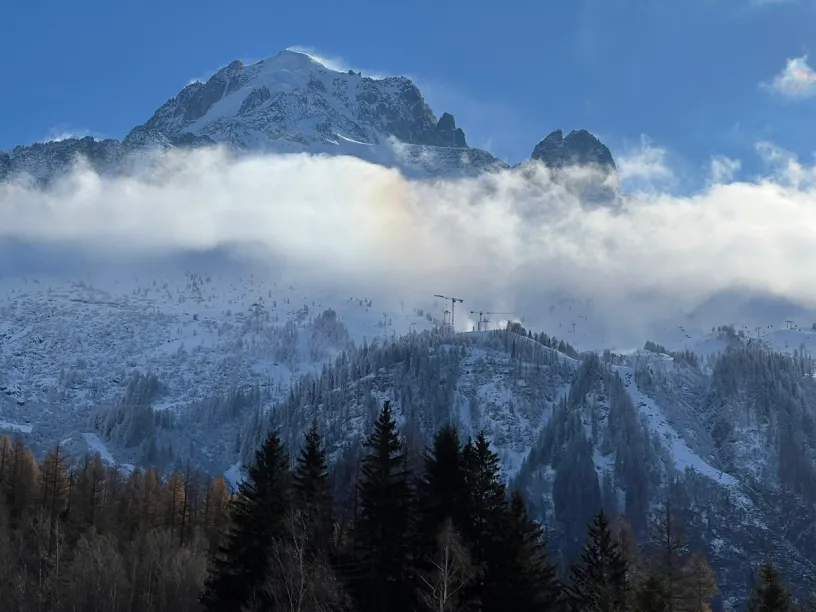
Then the CMB led us to the summit, where a breathtaking view opened onto the Grands Montets domain, the Mont-Blanc classified landscape, the Argentière Glacier basin, and the surrounding peaks, with the Aiguille Verte towering at 4,000 meters behind us… Around us, the peaks stood like queens and kings: the scale changes, perception changes.
With our feet in the snow, huddled like penguins in the cold, we admired the site, sketched our first vague ideas, and traced lines connecting three sites - first in the sky, then in the snow, and finally on a piece of paper.
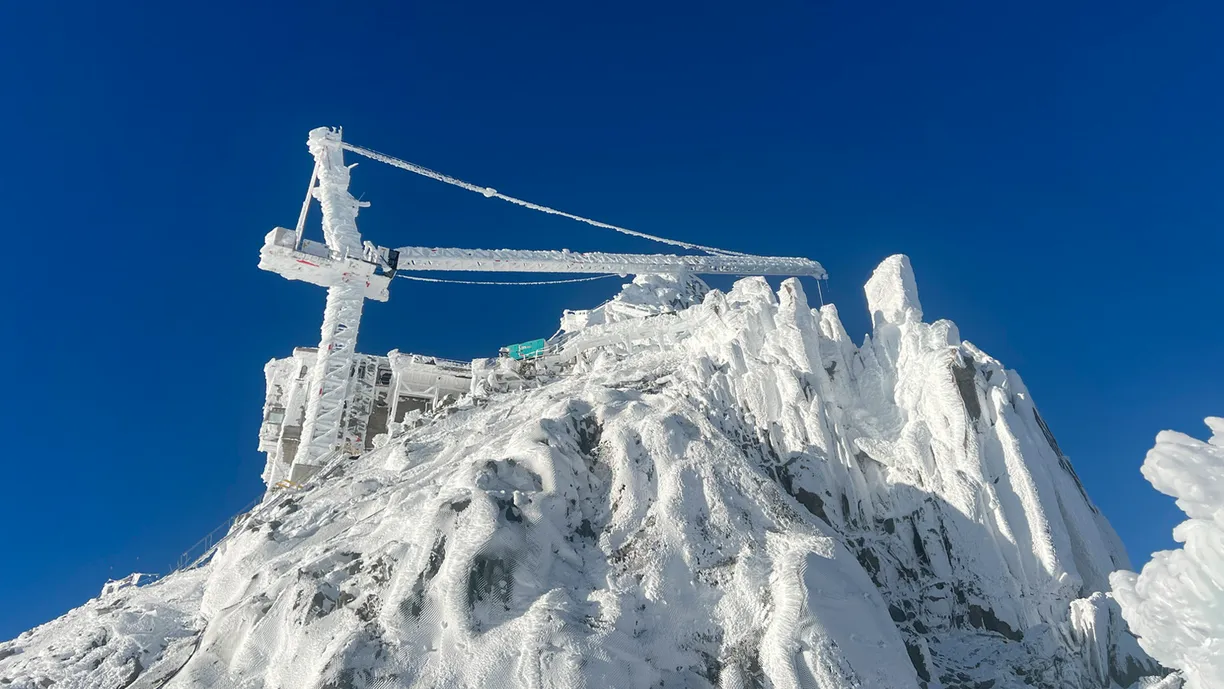
Now, after five years of study, with the design challenges overcome and the first construction seasons behind us, it was a magical moment to traverse the tunnel carved and blasted at +3,235 meters altitude, 65 meters below the summit of the Aiguille des Grands Montets, encountering veins of permafrost and touching granite surfaces that no one had seen before… For sure there will be more magical moments soon!
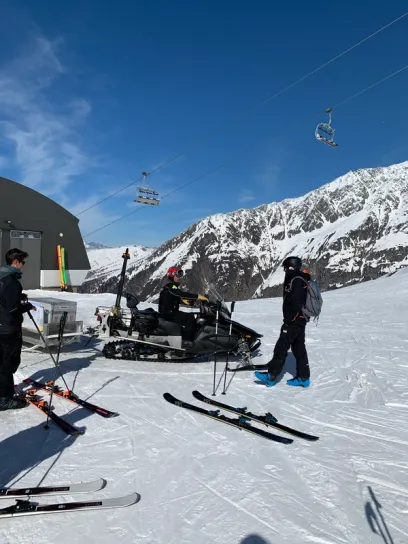
AC: The day we attended the first on-site meeting, fully winter-equipped, skiing
alongside our usual model crates strapped onto the back of a snow scooter, I
realized we were entering truly unique territory. This project would be different. It would transcend architecture and require us to let go of everything we thought we knew about responding to context.
HW: How did you balance the architectural and engineering imperatives to preserve the sense of ‘journey'; - both physically and emotionally - for users travelling from valley to summit?
AC: A cable stretching more than 5 km and climbing nearly 2,000 meters, linking
three sites, three buildings, and three environments, each with its own character and demands, made tangible for everyone the notion of coherence we so often invoke in our design process. Yet this clarity also revealed the real challenge: remaining humble and subtle in the presence of a natural landscape that requires no embellishment, only a calm and sheltered place to contemplate it.
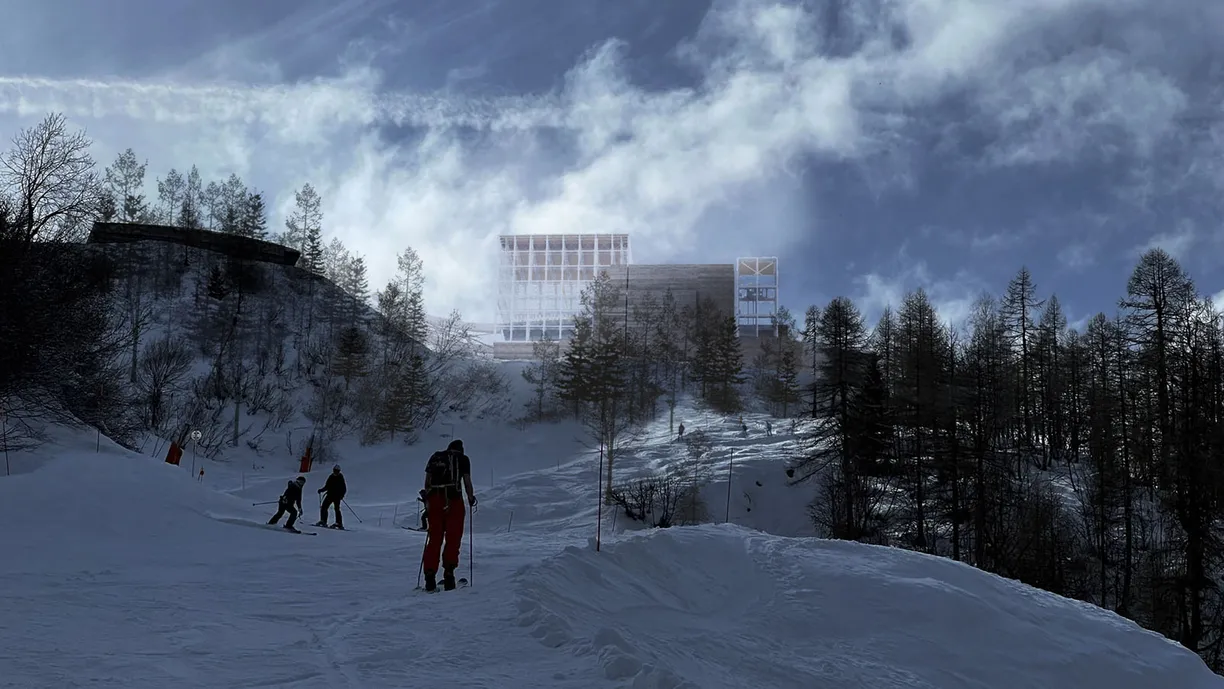
In such a breathtaking context, the task became clear from day one: to create the most transparent and weightless envelope possible, an apparently simple skin sheltering an intricate machine, engineered to withstand winds of 260 km/h and up to 5–6 meters of snow. The structure spans a 20 × 40-meter machinery area without transmitting any load to it, making it one of the most technically demanding buildings the office has ever undertaken.
Despite a lifetime spent on the slopes, we rarely pause to observe the ophisticated engineering behind the lifts we depend on. For the design team, understanding this machinery required a return to fundamentals, learning a new vocabulary to ensure the machine could express itself properly within the architecture that frames it.
CB: We have kept the project very sober, frugal, and clear, reducing it to three key elements: the crystal - the machine -the topos.
We sought an overall coherence while adapting locally, consistently repeating the same elements in proportion to each site and connected by cable. The ropeway cables serve as our “red thread,” linking the sites both physically and metaphorically.
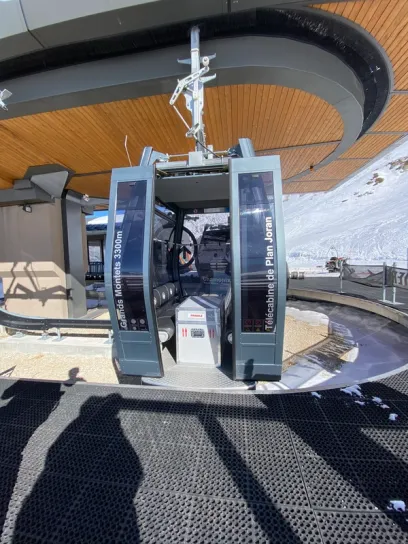
The machines are highlighted as the focus of the contemplative journey. They are housed in glazed volumes, the crystals, that allow views of the surrounding protected landscape, inviting appreciation of their mechanical fascination. We chose a neutral color palette for the architecture, with accents only on the elements that move, which are painted red—such as the ropeway pulleys or the elevator cabin. This was convenient, as the ropeway code already requires the pulley to be colored.
Additionally, a mountain is usually considered stable, strong, and eternal. But this is no longer the case in the context of climate change. In contrast, the crystal is a delicate, filigree-like structure engineered to withstand extreme forces: winds
exceeding 260 km/h and up to 1 ton of snow per square meter on the roof, for
example.
HW: Tell us something about the design choices you made for the project.
CB: A great deal of attention, energy, and time has been devoted to the modular
system that shapes the two “crystals”—highly transparent architectural volumes
supported by a metal framework, which Renzo calls “the lace.” We developed a
modular system specifically designed for high-altitude construction. The modules will be prefabricated and pre-assembled in the factory, then transported via blondins (aerial cable cranes) to Lognan and the Aiguille. Just over 300 modules, each featuring an identical central node, a steel cast piece, will be assembled using a shear-key system that allows structural forces to be transmitted. Each piece is designed and manufactured with high-tech precision, yet remains “mid-tech” in its installation, allowing it to be carefully positioned under extremely challenging conditions in high altitudes.
For the opaque counterpart, a sober approach using a mixed wood-concrete
structure was chosen. The buildings, featuring either green or mineral roofs
depending on the site, are highly visible in the mountain landscape as a “fifth façade” and are designed to interact with the surrounding topography. They follow the contour lines of the plateau at Lognan and the slopes of the summit at the Aiguille. Spaces requiring greater height are integrated into the slopes to minimize their perceived volume and maintain visual balance.
AC: We often encourage our consultants, clients, and contractors to achieve the
cleanest, lightest, and slightest possible details, but on this project, we had to learn a different form of modesty. In such an extreme environment, the force and power of nature shape human activity more profoundly than anywhere else. Finding the right balance between architectural and aesthetic ambition and the need for functional, reliable, and resilient detailing became our greatest challenge.
As the client once reminded us: “You are thinking like rain falling on a city, always vertical, at worst slightly inclined. At 3,200 meters, snow also falls horizontally, and sometimes it even comes from below.”
HW: What sustainability methods have guided the construction?
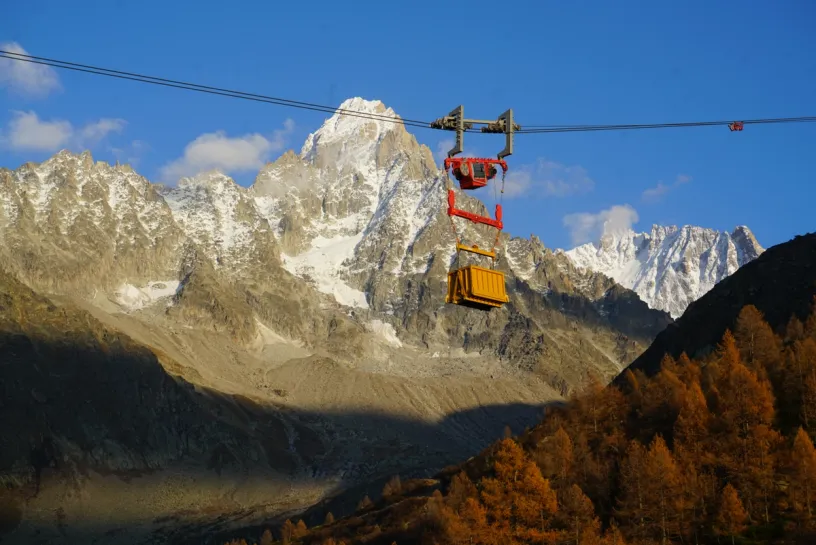
CB: Construction is currently in progress. Site logistics represent a significant portion of the overall costs. Two sections of “blondins” have been installed on-site to transport construction materials, keeping the need for helicopters to an absolute minimum. A blondin is an aerial cable transport system that acts like a linear crane, allowing heavy loads and materials to be moved in areas that conventional machinery cannot access.
The project, spanning three sites connected by a cable, is treated as a single
integrated operation, encompassing the buildings as well as all components of the ropeway system, including machinery, pylons, and cables.
This approach is part of the effort to obtain a French label called HQE (High
Environmental Quality) Infrastructures, which is designed to assess, enhance, and certify the environmental and sustainable performance of infrastructure throughout its lifecycle. Although HQE certification is typically applied to roads, railways, bridges, tunnels, airports, and similar projects, it is being used here to ensure the highest standards of environmental and operational sustainability. Its application to the ropeway system represents a novelty, still very rare in this type of project.
To date, we have obtained the “Program and Design – Mixed” certification.
The next step will be an on-site audit in 2026 to monitor the construction for the
certification.